-1.png?width=100&height=75&name=original-tar-ruler%20(1)-1.png)
Contents
How the Deferred Revenue Workflow Works
🆕 What’s New (QuickBooks Online ONLY)
Builder Prime now supports:
- Multiple deposit invoices (no longer limited to one)
- Flexible deposit amounts (no 50% cap)
- A new option to recognize revenue only at the end of the project
Your Two Invoicing Options
Builder Prime now offers two ways to handle deposits and revenue:
1. Standard Workflow (Original Behavior)
- One deposit invoice (up to 50%)
- Additional invoices can be created throughout the project
- Revenue is recognized gradually as invoices are created
👉 Best for companies that want revenue tracked throughout the project
2. Defer Revenue to Final Invoice (New + QuickBooks Online ONLY)
- Create multiple deposit invoices at any stage
- Deposits are recorded as liabilities only
- All revenue is recognized on the final invoice
👉 Best for companies that:
- Collect multiple deposits (materials, scheduling, etc.)
- Prefer revenue to be recognized only when the job is complete
How the Deferred Revenue Workflow Works
- Create Deposit Invoices
- Collect deposits at different stages of the project
- All deposits are sent to your liability account in QuickBooks
- Create the Final Invoice
- One final invoice is created for the remaining balance
- This invoice triggers full revenue recognition
- Revenue Is Recognized
- QuickBooks moves the total from liability → revenue
- No manual adjustments required
Example
Contract: $10,000
- Deposit 1: $5,000
- Deposit 2: $3,000
- Final Invoice: $2,000
Result:
- $8,000 held as liability until completion
- Final invoice recognizes full $10,000 as revenue
Change Orders and Deposits
How change orders behave depends on when they are made in relation to the final invoice.
Before the Final Invoice
If a change order is created before the final invoice:
- Deposit invoices automatically adjust to the updated contract
- Remaining balances are recalculated
- You can proceed with invoicing as normal
👉 No special action is required
After the Final Invoice (Not Yet Synced)
If you are using “Skip Final Invoice Until Job Complete” and the final invoice has been created but not yet synced to QuickBooks:
- You can still update or delete the final invoice
- Then recreate it to reflect the updated contract
👉 This gives you a window to make adjustments before revenue is finalized
After the Final Invoice Has Synced
If the final invoice has already synced to QuickBooks:
- Existing invoices will not automatically update
- You will need to:
- Adjust invoices manually in QuickBooks, or
- Create a journal entry
👉 Builder Prime cannot modify transactions that are already recorded in QuickBooks
When Deposits Equal 100% of the Contract
If a change order reduces the contract value and your existing deposits now total 100%:
- A final invoice cannot be created
You have two options:
- Convert the most recent deposit invoice into a final invoice, or
- Record the adjustment manually in QuickBooks
Best Practices
- Finalize all change orders before creating the final invoice
- If using deferred revenue, consider enabling:
- “Skip Final Invoice Until Job Complete”
This gives you more flexibility to make adjustments before revenue is recognized
- “Skip Final Invoice Until Job Complete”
Key Rules to Know
- Deposit totals must stay below 100% of the contract
- Only one final invoice is allowed in the deferred workflow
- The final invoice must bring the total to 100% of the contract
- Deposit invoices cannot be edited after the final invoice is created
- Revenue tracking does not include tax
Choosing the Right Workflow
Use Standard Workflow if you:
- Want revenue recognized throughout the project
- Use progress invoicing
Use Deferred Revenue if you:
- Collect multiple deposits
- Want cleaner, end-of-project revenue recognition
Setup
These options can be configured in your QuickBooks Integration Settings → Accounting tab:
- Set Default Deposit Accounting Code (will sync deposits to your designated liability account)
- Defer Revenue to Final Invoice (enables multi-deposit workflow)
- Skip Final Invoice Until Job Complete (optional timing control)
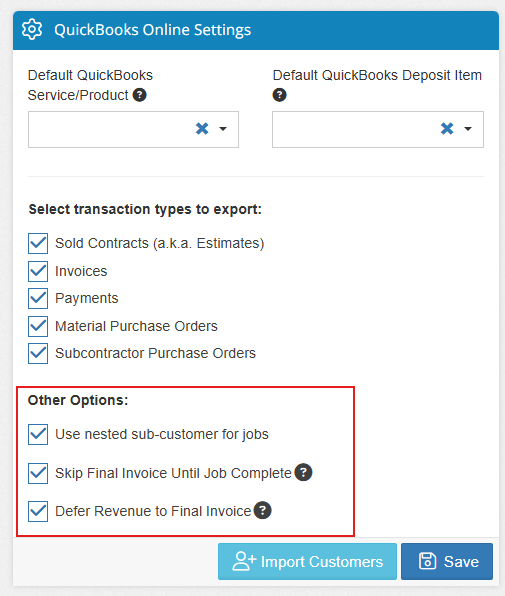
Note:
- These settings apply to QuickBooks Online only
- Workflow must be selected before creating the first invoice on a project
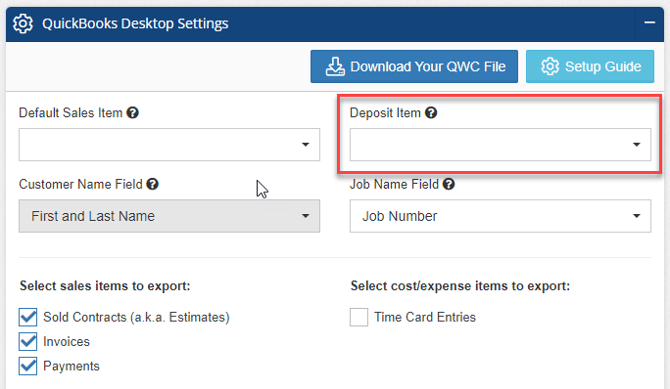
The default accounting code for deposits is set within the Accounting configuration page.
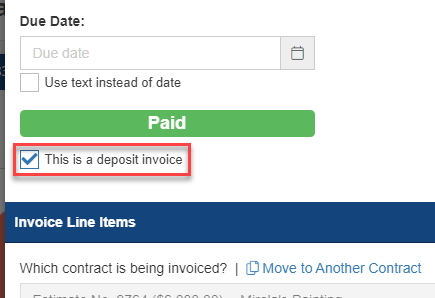
The deposit invoice would indicate the amount against the liability account. The subsequent invoice(s) would enter a negative amount against the liability item and add the same amount to the receivables item.
Frequently Asked Questions
Q: Can I still use the old single-deposit workflow? Yes. If you leave "Defer Revenue to Final Invoice" unchecked (or disable it on a specific project), the system behaves the same as before with the single deposit invoice and progressive revenue recognition.
Q: What if I don't use deposit invoices at all? That's fine. This feature does not force you to use deposit invoices. If you don't mark any invoices as deposits, your invoices will sync to QuickBooks as normal revenue transactions.
Q: Does this apply if I'm not connected to QuickBooks Online? No. These workflow settings only apply to QuickBooks Online-connected accounts. Revenue recognition is handled in QuickBooks, not within Builder Prime. If you are not integrated with QuickBooks Online, these settings have no effect.
Q: Does this work with QuickBooks Desktop? No. This feature is available for QuickBooks Online integrations only.
Q: Can I switch a project from "Defer Revenue to Final Invoice" to the Standard Workflow after I've started invoicing? No. Once the first invoice is created on a project, the invoicing workflow is locked for that project. Choose your workflow before creating the first invoice.
Q: Why does the recognized revenue amount not match my invoice total? Revenue recognition amounts do not include tax. Only the line item amounts before tax are used in liability and revenue calculations. The tax amount is handled separately and is not part of the revenue recognition figures.
Q: What if a change order makes my deposits equal 100% of the contract? You can convert the latest deposit invoice to a non-deposit invoice, which will trigger revenue recognition. Alternatively, you can create a journal entry in QuickBooks to manually recognize the revenue.
Q: What happens if I need to issue a refund after the project is complete? Refunds are handled as separate transactions (e.g., a refund receipt in QuickBooks) and will directly impact the revenue account. They do not affect the deposit or liability accounts.
Q: Who can change these settings? Both the QuickBooks Accounting tab settings and the project-level workflow setting require the Admin role and Company Setup permission.
Q: How does the project know which settings to use? When you create a project and select a class, Builder Prime pulls the default settings from the QuickBooks connection linked to that class. The "Defer Revenue to Final Invoice" setting is then stamped on the project and can be changed before the first invoice is created.
Here is an article that talks about how this would work with QuickBooks Online: https://quickbooks.intuit.com/learn-support/en-us/help-article/service-items/record-retainer-deposit/L6B5RsY6l_US_en_US
Here is an article that talks about how this would work with QuickBooks Desktop: https://www.gentlefrog.com/how-to-enter-customer-deposits-in-quickbooks-desktop/